
The .com Trust Premium: How Extension Choice Moves Conversion Rates
Does .com increase conversion rates? A pragmatic look at how domain extension shapes trust, click-through, and checkout behavior—and when the premium actually pays for itself.
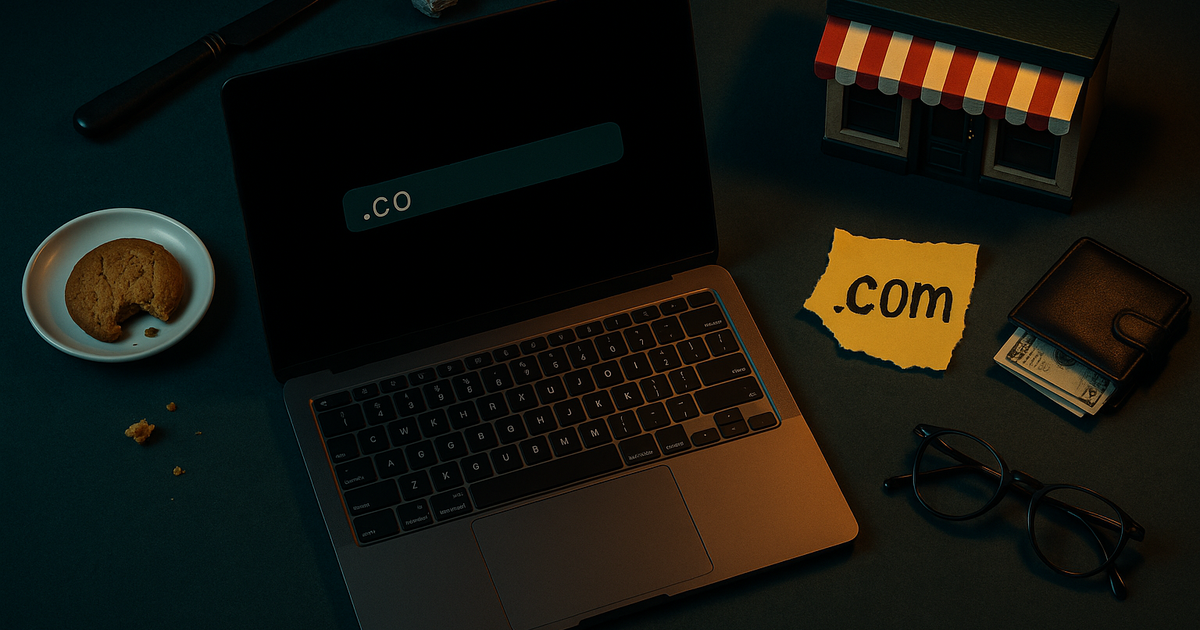
Every founder eventually hits the same fork: the perfect name is available on .io, .co, or .ai for a few dollars, but the .com is either taken or priced like a used car. The instinct is to treat the extension as cosmetic—a label that doesn't touch the fundamentals. It isn't. The extension sits in front of every transaction you'll ever run, and it quietly shapes whether a first-time visitor trusts you enough to hand over an email address, a credit card, or a signature.
So the real question—the one that belongs on a spreadsheet, not a mood board—is direct: does .com increase conversion rates? The honest answer is that it doesn't move conversion by magic. It moves conversion by removing friction from trust. And trust, at the margin, is what conversion is made of.
Why extension choice touches conversion at all
Conversion is a series of small permissions. A visitor decides your link is worth clicking, your page is worth reading, your form is worth filling, and your checkout is worth completing. At each step, the brain runs a fast, mostly unconscious credibility check. Anything that reads as slightly off raises the cognitive cost of the next click.
The .com extension carries three decades of accumulated default. For most U.S. consumers, ".com" isn't an extension—it's the sound a web address makes. When users type a brand into the address bar or autocomplete a search, they append .com without thinking. When they see an unfamiliar suffix, a small share of them pause. That pause is where conversion leaks.
This is a trust premium, not a ranking premium. Google has stated repeatedly that newer top-level domains carry no inherent SEO advantage or penalty—the extension itself doesn't rank you. The effect lives entirely in human perception, and human perception is exactly what a conversion funnel measures.
What actually happens at each funnel stage
The click: address-bar trust and typo leakage
Before anyone converts, they have to arrive. Two failure modes hit non-.com brands harder:
- Type-in leakage. A meaningful fraction of visitors will type your brand name plus ".com" out of habit. If you own brand.io but not brand.com, that traffic lands on a parked page, a competitor, or a 404—and it never enters your funnel at all.
- Click hesitation. In email, ads, and search results, an unfamiliar extension gets marginally fewer clicks from cautious users, particularly older and less technical U.S. audiences.
Neither effect is catastrophic on its own. Compounded across every channel, month after month, they become a persistent tax. We've written more on this in The Hidden Cost of Launching on a Non-.com Domain.
The page: perceived legitimacy in the first two seconds
Visitors form a credibility judgment about a site in well under a second, and the URL is part of that first impression—especially now that browsers surface the full domain prominently and phishing awareness is at an all-time high. When a shopper is deciding whether a store is real, a .com reads as "established" and an unfamiliar suffix reads as "prove it." You can absolutely overcome that with strong design, reviews, and trust signals—but you're spending effort to neutralize a doubt a .com never raised.
The checkout: where money makes people cautious
Trust friction scales with stakes. Nobody agonizes over an extension before reading a blog post. But at the moment of payment, when a first-time buyer is weighing whether their card details are safe, every ambiguity gets re-weighted. This is why the conversion gap between .com and alternative extensions tends to widen at the bottom of the funnel—precisely where each lost percentage point is most expensive.
How big is the effect—and when does it matter?
Here's the pragmatic part. The trust premium is real but context-dependent. It is largest when:
- You sell to mainstream U.S. consumers rather than developers or crypto-native audiences.
- You rely on first-touch, cold traffic—ads, SEO, cold outreach—where you have no prior relationship to lean on.
- Your product involves payment, personal data, or a leap of faith (e-commerce, fintech, health, high-ticket B2C).
The effect is smallest—sometimes negligible—when:
- Your audience is technical and extension-fluent, where .io, .ai, and .dev read as native.
- Most of your traffic is warm and repeat, arriving via saved links, apps, or brand recall.
- Your conversion event is low-stakes (a free signup rather than a purchase).
This is why blanket rules are useless. If you're comparing extensions for a technical product specifically, the tradeoffs deserve their own analysis—see .com vs .io for Startups: Which One Actually Wins Long-Term?. And the broader question of whether you can build a durable brand off a non-.com is worth reading in full: Can You Build a Brand Without the .com? What the Data Says.
Turning the trust premium into a number
Operators don't need to believe the premium—they need to price it. The math is more approachable than it looks:
- Estimate the conversion delta. Even a conservative 1–3% relative lift in conversion from removing extension friction is a defensible planning assumption for cold consumer traffic.
- Apply it to lifetime value. Multiply the delta by your annual new-customer volume and average customer value.
- Add the recovered type-in traffic. Traffic that currently leaks to the .com you don't own is traffic you'd capture the day you acquire it.
- Compare to acquisition cost. Weigh that recurring annual value against the one-time price of the domain.
Framed this way, a premium .com stops looking like a vanity expense and starts looking like what it is: an asset that lowers customer-acquisition cost for the life of the business. We built a full model for this in How Much Should a Startup Pay for a .com Domain? A Budget Framework.
If the .com is already taken
Most great names are registered—that's a feature of a mature market, not a dead end. A held .com is often acquirable, and the negotiation is more structured than founders expect. Our walkthrough on How to Acquire the .com When Someone Else Owns It covers outreach, valuation, and closing without overpaying. And if you're wondering whether the extension matters to the people writing your checks, the reporting in Do Investors Care If Your Startup Has the .com? is worth the read before your next raise.
The extension isn't the brand. But it's the doorway every customer walks through to reach the brand—and doorways that stick cost you nothing to see and everything over time.
The strategic read
Does .com increase conversion rates? Not on its own—but it consistently reduces the trust friction that suppresses conversion, most sharply where money and cold traffic meet. For a technical tool with a warm, extension-fluent audience, an alternative extension can be entirely defensible. For a consumer brand asking strangers to trust it with a purchase, the .com premium usually pays for itself faster than founders assume. The discipline is to run your numbers, not the internet's opinions.
PixelWorks Domains curates premium .com inventory for operators who treat naming as infrastructure, not decoration. If you want to browse names built to carry trust from the first click—or discuss acquiring a specific .com that's currently held elsewhere—we're glad to help you think it through around the outcome, not the sale.