How the .com Affects Startup Exit Valuation and Acquisition Multiples
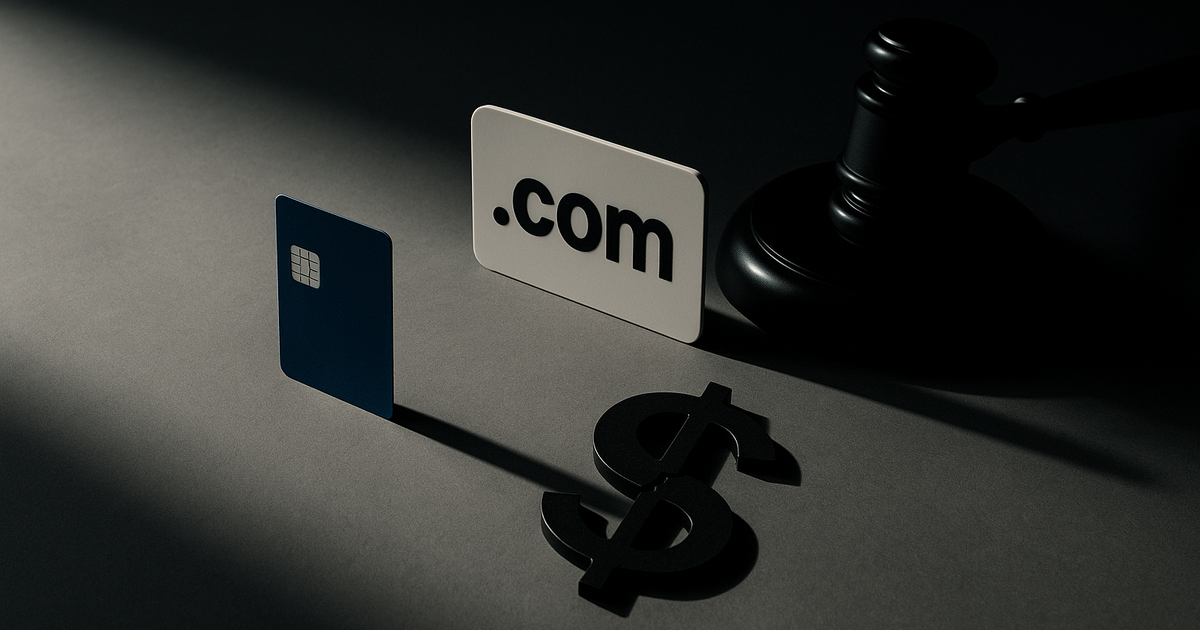
The domain rarely appears as a line item in a term sheet—but it quietly shapes multiples, diligence friction, and negotiating leverage. Here's how the .com moves startup valuation at exit.
When a startup sells, the headline number gets all the attention. But acquirers don't buy headlines—they buy assets, and they price risk. The domain is one of those assets. It's rarely broken out as its own line on a term sheet, yet it shows up everywhere: in brand equity, in diligence friction, in the confidence a buyer has that the name they're acquiring is actually theirs to keep. Understanding how a .com domain affects startup valuation means understanding how acquirers think—and where a matching .com quietly compounds value while a mismatched one quietly erodes it.
The domain is an asset, not a detail
In an acquisition, the buyer is purchasing a bundle: revenue, IP, team, customer relationships, and the brand itself. The domain sits at the intersection of brand and IP. A clean, exact-match .com signals that the acquirer is buying a coherent, defensible identity—one they won't have to rebuild, redirect, or defend against a squatter the week after close.
Compare two otherwise identical companies. One owns brand.com. The other operates on getbrand.io while a parked brand.com sits with a third party. The second company carries a latent liability: at some point, the acquirer will want the matching .com, and that cost—plus the uncertainty of whether it's even available—gets discounted into the offer today. The domain didn't lower the revenue. It raised the perceived risk.
Why acquirers price the .com into the multiple
Acquisition multiples are, at their core, a proxy for confidence. A buyer paying 6x revenue instead of 4x is expressing certainty—about durability, about defensibility, about the absence of nasty surprises. The domain feeds directly into that confidence in a few concrete ways.
1. Brand defensibility
Owning the exact-match .com reduces the odds of confusion, impersonation, and traffic leakage. Acquirers integrating a company into a larger portfolio don't want to inherit a brand that shares its name with a parked page, a competitor, or a phishing risk. A consolidated domain position is one less thing to fix post-close, and "one less thing to fix" is exactly what expands a multiple.
2. Diligence friction
Deals die in diligence more often than in negotiation. If the domain ownership is messy—held in a founder's personal registrar account, tangled in a lease-to-own arrangement, or reliant on a non-.com while the .com is unsecured—that friction shows up as delay, legal cost, and doubt. A cleanly held, matching .com is boring in the best possible way. Boring closes deals.
3. Migration and rebrand risk
If an acquirer suspects they'll eventually need to move the company onto the matching .com, they're pricing a future rebrand: SEO disruption, email deliverability resets, marketing collateral, and customer re-education. We've covered the mechanics of that drag in The Hidden Cost of Launching on a Non-.com Domain. At exit, that hidden cost stops being hidden—it becomes a discount.
Where the .com shows up in the numbers
It's tempting to assume the effect is purely psychological. It isn't. The domain touches several metrics acquirers actually model.
- Customer acquisition cost: A memorable, direct-navigable .com lowers reliance on paid channels over time. Buyers reward efficient acquisition with higher multiples.
- Organic authority: A domain that has accumulated backlinks, brand searches, and search authority on the primary asset is worth more than authority scattered across a secondary domain. If your SEO equity lives on the wrong host, some of it is stranded.
- Type-in and referral traffic: Direct navigation is the cheapest traffic there is. A clean .com captures it; a non-.com leaks a share of it to whoever owns the .com.
- Integration cost: The lower the cost to fold the brand into an acquirer's stack, the more of the purchase price flows to enterprise value rather than remediation.
How much does it actually move the number?
There's no universal multiplier—anyone quoting a precise "the .com adds 15%" figure is selling something. The impact scales with deal size and buyer type. For a small acqui-hire, the domain may be a rounding error. For a strategic acquisition where the brand is the point—a consumer product, a category-defining SaaS, a name the acquirer intends to build on for a decade—the matching .com can be decisive, both to the multiple and to whether the deal happens at all.
The pattern we see: the more the acquirer values the brand as a durable, standalone asset, the more the .com matters. Financial buyers optimizing cash flow care less. Strategic buyers building for the long term care a great deal. And notably, the investors funding you earlier in the journey often signal the same instinct—we unpacked that in Do Investors Care If Your Startup Has the .com? What VCs Actually Say.
The .com rarely wins a deal on its own. But a missing one gives a buyer a reason to shave the number—and reasons to shave the number are exactly what negotiators hunt for.
The counterargument: plenty of exits happen without it
Fair. Companies exit on .io, .ai, .co, and country-code domains constantly, sometimes at enormous valuations. The domain is one variable among many, and a great business on the wrong extension still beats a mediocre business on a perfect one. If you're weighing whether the extension is a dealbreaker or a discount, Can You Build a Brand Without the .com? looks at what the evidence actually supports.
The honest framing is this: the .com is a tailwind, not a prerequisite. It reduces friction, protects optionality, and gives you leverage in the room. Absent it, you can still exit well—you just want to have made that choice deliberately, with eyes open to the discount you may be accepting.
Securing the .com before you need it
The worst time to acquire your matching .com is during exit diligence, when the counterparty knows exactly how badly you need it and prices accordingly. The best time is early, or at least before a transaction is on the table. If someone else holds your name, the playbook for approaching them is in How to Acquire the .com When Someone Else Owns It, and if you're building the budget from scratch, How Much Should a Startup Pay for a .com Domain? gives you a framework that treats the purchase as an investment rather than a cost.
A few operator-level moves that protect valuation:
- Hold the domain in the company, not a founder's personal account. Clean ownership is clean diligence.
- Consolidate authority on the primary domain so your SEO and brand equity aren't stranded on a secondary host.
- Lock down obvious variants and typos to reduce confusion and impersonation risk a buyer would otherwise flag.
- Keep registration current and transferable—expired or locked domains create avoidable friction at close. ICANN's registrant guidance is a useful baseline for what clean ownership looks like.
The strategic takeaway
The .com doesn't sit in a spreadsheet cell labeled "domain value." It works through the numbers—compressing acquisition cost, concentrating authority, reducing diligence friction, and, most of all, giving acquirers fewer reasons to discount. In a market where multiples are really a measure of confidence, owning the exact-match .com is one of the cleaner ways to buy yourself confidence you can later sell.
If you're building toward an exit—or acquiring a company and want its domain position airtight—it's worth treating the .com as the strategic asset it is. Browse the curated inventory at PixelWorks Domains, or reach out about a specific acquisition, and let's talk about what a cleaner domain position could do for your valuation trajectory.