.com or the Cheaper Ending: What the Price Gap Actually Buys You
A .com often costs more than .net, .biz, or .co. Here's what that extra money really buys a small business—and when the cheaper ending is fine.
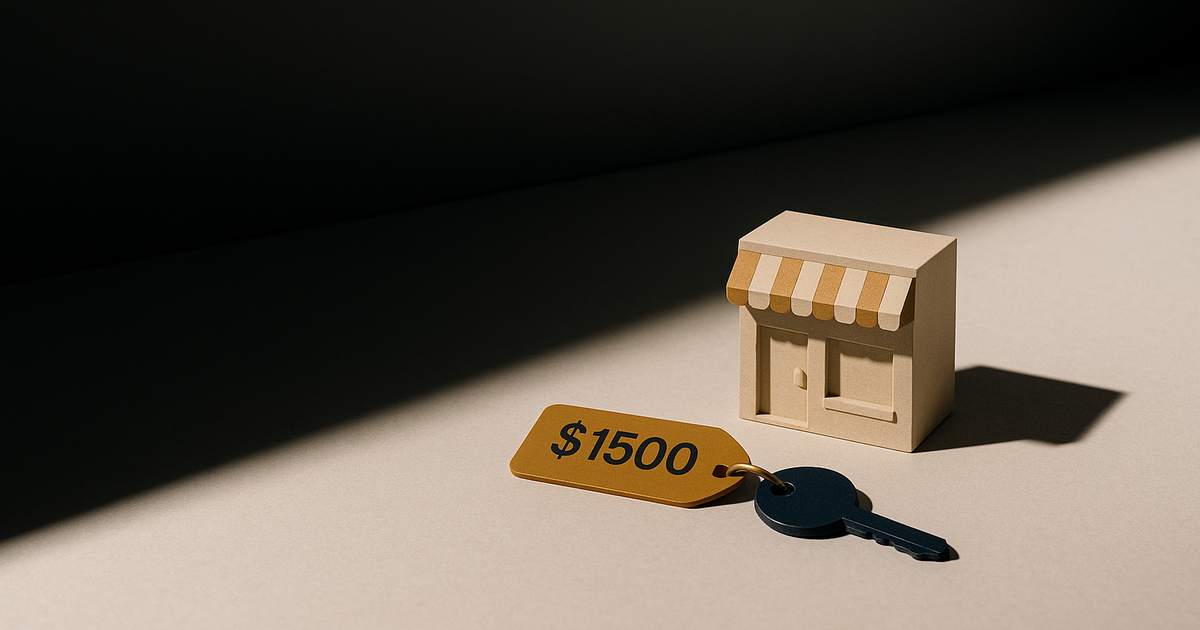
You found the name you want. Then you see the catch: the .com costs a few hundred dollars, and the same name with .net, .co, or .biz is ten bucks. So you ask the fair question: is a .com worth paying more than a cheaper domain extension?
Short answer: usually yes, but not always. Here's how to tell which one you're in.
What the ending actually is
The ending is the last part of your web address. The .com in yourshop.com. Others include .net, .org, .biz, .co, .info, and newer ones like .plumbing or .shop. They all work the same way behind the scenes. A .co site loads just as fast as a .com. Google doesn't rank .com higher because it's .com.
So if the tech is the same and Google doesn't care, why pay more? Because your customers care, even if they can't tell you why.
What the price gap buys you
You're not paying for better technology. You're paying for a habit your customers already have. When people hear a business name, most of them type it and add .com without thinking. It's the default in their head. That's the whole thing.
Here's what that habit is worth in plain terms:
- Fewer lost visitors. Say your name out loud on the radio, on a truck, or to a neighbor. If you own the .com, the people who guess wrong still land on you. If you own the .net and someone else owns the .com, you just sent a paying customer to a stranger.
- Fewer "which one was it?" moments. A customer who saw your card last week will try .com first. If that's not you, they may give up before they find the right ending.
- It looks established. Fair or not, a lot of people read .com as "real business" and an odd ending as "maybe not." For a clinic, a contractor, or a shop, that first read matters.
None of this shows up on a bill. It shows up as calls you never got and don't know you missed. That's the trap with cheaper endings: the cost is invisible.
When the cheaper ending is fine
Sometimes it really is fine to skip the .com. A few honest cases:
- You almost never say your address out loud. If every customer comes from a Google Business Profile, a map pin, or a booking link they click, the exact ending matters less. They tap, they don't type.
- The .com you want is parked at a crazy price and the .co version is clean and short. A short, clear .co beats a long, clumsy .com. The name still comes first.
- The other ending fits your trade and reads clearly. Something like yourname.shop can work if it's easy to say and spell. Just test it: read it to someone once and ask them to type it.
The rule underneath all this is simple. A name people can say and spell is worth more than the ending on the end of it. We dug into that trade-off in The Real Cost of a Hard-to-Spell Domain, and it applies here too: a clean .co beats a confusing .com every time.
Do the math on your own situation
Skip the gut feeling and run the numbers. Two costs are in play.
The .com price
A good local .com might be a one-time price in the hundreds or low thousands, plus a small yearly renewal (usually $10–$20). Don't mix those two up. We break down the difference in One-Time Price vs. Yearly Renewal.
The cost of guessing wrong
Now guess how many people a year hear your name and try to type it. Radio ad, van, jobsite sign, word of mouth. Even a slice of those going to the wrong ending adds up fast. One landed customer for a contractor or clinic can be worth more than the whole price of the .com. We walk through that count in How Many New Customers a Better Domain Has to Win to Pay for Itself.
If a handful of missed customers a year covers the price, the .com pays for itself and keeps paying. If almost nobody types your name and you're all clicks and maps, the cheaper ending is a reasonable call.
Common mistakes to avoid
- Buying the cheap ending, then buying the .com later anyway. Many owners do this after a competitor grabs their .com. You end up paying twice and losing traffic in between.
- Picking an odd ending just to force a clever spelling. If people can't say it and land on you, the price wasn't the problem.
- Thinking Google punishes non-.com sites. It doesn't. Google's own guidance on helpful content is about your pages, not your ending.
The bottom line
For most small and local businesses, the .com is worth the extra money because it matches what your customers already do without thinking. You're not buying better tech. You're buying the version of your name people guess first. When your name gets spoken out loud a lot, that's easily worth the gap. When it doesn't, a clean cheaper ending can hold its own.
Want to see what's realistic for your name? Take a minute and read how a say-it-out-loud name cuts your ad costs, then browse names for your city or trade. If one specific domain is on your mind, ask us about it. No pressure either way—we'd rather you decide it's worth it first.